An onlooker once told me, after we finished an office first aid training, that the only reason he registered was since his manager firmly insisted. 6 weeks later on he used those skills on his papa, who fell down at a family members bbq. The rescue team informed him candidly: beginning CPR very early possibly saved his papa's brain.
He did not keep in mind every acronym or every slide. What he did keep in mind was how it felt to stoop close to a manikin, lock his joints, and keep going until assistance got here. That muscle mass memory is precisely what a well run fast first aid course is designed to build.
Fast, express, compressed, sped up - the tags vary, therefore does the top quality. If you wish to go from absolutely no to accredited without losing time or cash, it aids to comprehend what you are in fact acquiring when you look for a "fast first aid course near me".
This overview walks through the realities behind fast first aid and CPR training, what a great course needs to cover, and how to choose an option that fits your routine without cutting corners on safety.
What "fast" truly implies in first aid training
Fast first aid training does not imply careless or insufficient, a minimum of not when it is done effectively. In technique, speed typically comes from two things: concentrating tightly on core skills, and making use of combined distribution so you complete concept online and keep classroom time for hands on work.
A credible fast first aid course or fast cpr course is normally:
- Short in overall hours compared with multi day conventional courses, frequently 3 to 6 hours of call time plus pre learning. Focused on the most typical life threatening emergency situations, as opposed to every uncommon circumstance in the textbook. Highly structured, with extremely little downtime, side babble, or redundant content.
That trade off works well for most individuals. The first aid and cpr abilities that genuinely matter in the very first couple of minutes of an emergency are not made complex. Early CPR, very early defibrillation, standard bleeding control, safe positioning, and calling for assistance will certainly save much more lives than an excellent bandage on a sprained ankle.
Where speed comes to be an issue is when providers slash off the moment needed to exercise. You can watch CPR video clips throughout the day, however up until you in fact push on a chest and feel just how deep and fast appropriate compressions are, you do not have the ability. Fast first aid courses that avoid or hurry functional evaluation typically produce paper certificates, not qualified responders.
When you assess express first aid courses or express cpr courses, always ask how much hands on time is included, not simply the advertised duration.
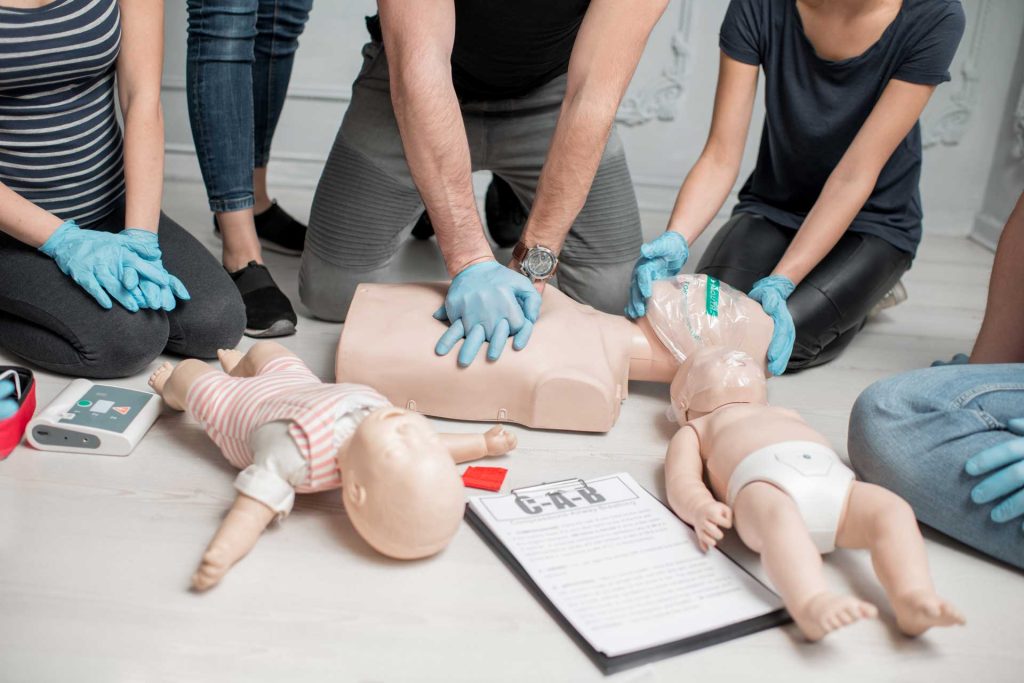
Core skills you need to walk away with
Whether you reserve an office first aid training, an express child care first aid course, or a weekend CPR refresher, the end results should feel surprisingly similar. The context and added topics may transform, yet the foundations stay constant.
By the end of a strong first aid and cpr course, you ought to have the ability to:
Recognise an emergency situation promptly. That sounds apparent, but I have actually seen grownups stand iced up by a flattened associate because Adelaide first aid they were uncertain if they were "overreacting." Fast courses utilize circumstances to educate that first psychological action: this is not regular, I need to act.
Check responsiveness and breathing safely. You require to understand just how to approach, exactly how to open a respiratory tract, and how to determine whether breathing is normal or otherwise. Numerous learners take too lightly just how agonal gasps look and sound. Excellent cpr training constantly clears up this.
Call for assistance effectively. Dialing emergency solutions is not simply pressing three numbers. In class we practice what to claim, just how to explain the location, and how to turn over to someone else without chaos.
Start CPR with self-confidence. That includes right hand setting, compression deepness and rate, safe air flows if required in your local protocol, and exactly how to swap rescuers if there are 2 individuals. Fast cpr courses focus hard on this, frequently utilizing responses manikins that reveal whether your compressions are deep enough.
Use an AED without hesitation. Modern defibrillators are very user friendly, yet individuals still fret about "doing it incorrect." An efficient first aid and cpr training course allows you open an AED, location pads, comply with prompts, and handle practical questions like upper body hair or water.
Control life intimidating bleeding. Direct pressure, standard dressings, and when to use a tourniquet or haemostatic dressing if those become part of your work environment kit.
Position and monitor a casualty. Recovery placement for someone who is breathing but unresponsive, resting placements for breathing problem, and recurring checks until aid arrives.
On top of this, various first aid courses layer on topics such as choking, burns, cracks, allergies, diabetic emergency situations, and seizures. Fast first aid course carriers sometimes press these right into scenarios as opposed to separate lectures. The aim is still the exact same: you should have the ability to ensure, simple decisions under stress.
Types of fast and express first aid courses
Once you begin searching, the food selection of choices grows quickly. From a trainer's side, there are a couple of usual patterns.
General fast first aid course
This is the timeless short, wide program that covers adult standard life assistance, blood loss, common injuries, and basic ailment recognition. It matches office workers, volunteers, and any individual who wants a first aid certificate for basic life instead of a certain job requirement.
Duration varies by country and certification, yet a common fast first aid training session runs for half a day face to face, supported by 1 to 3 hours of online pre learning.
CPR just and fast cpr refresher course
If your single emphasis is resuscitation, try to find targeted cpr courses or express cpr training. These fast cpr courses centre on:
- Adult CPR and AED for solitary rescuer Sometimes youngster and infant CPR, relying on the program Special situations like drowning or injury if time allows
A fast cpr correspondence course is ideal if you currently hold a certificate and intend to maintain your skills current. In several territories, CPR needs renewing every year for workplace or specialist conformity. In technique, I suggest a refresher a minimum of every 1 to 2 years for everybody. Method drifts, self-confidence discolors, and standards do change.
Express childcare first aid course
Parents, early childhood years teachers, and institution staff normally need more than grown-up CPR. Express child care first aid courses focus on:
- Infant and youngster CPR Choking monitoring for babies and children Fever, seizures, allergic reactions, and asthma Practical problems in child care settings, such as taking care of numerous children while responding
An express childcare first aid training session may still be only one day, yet the study and material alter heavily toward pediatric circumstances. If you work with kids, pick this over a common course. The emotional tons of treating a youngster is extremely various, and practising on child and infant manikins matters.
Blended first aid and cpr course
Many carriers currently integrate on-line discovering with short, intensive sensible workshops. You total videos, tests, and concept modules in the house, then go to a fast first aid course in person for evaluation and hands on skills.
This format works specifically well for:
- Busy professionals who can not pay for numerous days far from work. Learners that such as to pause and rewind theory material. Organisations booking group first aid and cpr training classes on limited schedules.
The key is sincerity. You need to really complete the pre course components correctly. Browsing them and wanting to catch up in class rarely ends well.
What a well made fast first aid training day looks like
Not all "express" schedules are equal. When I create a fast first aid and cpr course, I function in reverse from what students must do capably prior to I authorize their first aid certificate, then build a tight schedule around that.
A normal personally day for a mixed or express first aid course may appear like this:
Short testimonial of pre knowing and essential principles, including questions. Demonstration and method of primary study, CPR, and AED, revolving through adult, kid, and baby manikins if covered. Scenario based practice of usual emergency situations such as choking, hemorrhaging, and unconscious breathing casualties. Practical assessment and debrief, with time for individual training and office specific questions.Notice exactly how the focus rests directly on doing, not listening. A well run express first aid training session really feels physically active, sometimes slightly laborious. If you find yourself resting for lengthy stretches viewing slides, you are not in a fast course, you are in a sluggish lecture with a brief schedule.
How "from absolutely no to accredited" in fact works
People typically worry that they have no standard understanding. That is not an issue. In many methods, learners that involve first aid fresh, without fifty percent remembered misconceptions from decades previous, are easier to teach.
The journey from absolutely no to accredited in a fast first aid or express cpr course usually plays out in three stages.
First, you create a mental map. Throughout online modules or early in the course, you find out the framework: look for threat, check action, call for assistance, start compressions, utilize an AED. You become aware of the recuperation setting, serious blood loss, and choking. This is where mnemonics and simple flowcharts help.

Second, you layer in muscle mass memory. You kneel down, position your hands, press, and really feel the resistance in the manikin's breast. You practise rolling a person into recovery position. You apply plasters, practice your words for an emergency situation phone call, and walk through exactly how you would handle a subconscious associate in your real workplace.
Third, you confirm you can place it together under light stress. Throughout evaluation, you respond to timed scenarios, typically with a partner. You do not require to be excellent. You do require to be safe, fairly confident, and able to adhere to the core series without coaching.
That is the actual point of fast certification. The paper certificate or electronic badge just matters since it indicates that an assessor has actually watched you get the job done to a clear standard.
Choosing the best fast first aid course provider
I have actually taught for large nationwide organisations and small regional groups. Dimension alone does not predict quality. What matters much more is just how seriously the service provider takes both conformity and learning.
Here is a simple list that assists when contrasting fast first aid courses or express cpr courses.
- Accreditation: Are their first aid and cpr courses identified by the authority or sector body pertinent to your job or nation? For work environment conformity, this is non negotiable. Instructor experience: Do they make use of trainers with frontline or real world histories, such as paramedics, registered nurses, or seasoned first aid teachers, and do they get continuous training themselves? Practical time: How many hours are truly hands on, with manikins and circumstances, instead of slides? If the response is "a quick run through at the end," appearance elsewhere. Blended style: If the course is short, do they provide significant pre knowing or on the internet modules, or are they attempting to load every little thing into a cramped classroom block? Reviews and responsiveness: Do previous individuals point out feeling great after that, and does the organisation solution inquiries plainly before you book?
When browsing online for a "fast first aid course near me" or "express first aid course," use this checklist as a filter. Advertising and marketing language can be glossy. Certification information and schedules are harder to fake.
How regional rules and work environment needs change the picture
Regulations around first aid course web content, length, and revival frequency differ extensively. In some regions, a standard complete first aid and cpr course is expected to be at least one complete day. In others, a 3 to 4 hour mixed course suffices if the supplier satisfies certain assessment criteria.
Workplace role shapes your option as well. A couple of instances from technique:
A childcare worker generally needs an express childcare first aid certificate that clearly covers pediatric CPR, asthma, and anaphylaxis, renewed every 1 to 3 years depending on local law.
A building site very first aider might require a more detailed fap first aid or comparable program that covers crush injuries, ecological direct exposure, and trauma, also if provided in an increased format.
A health club instructor can often satisfy their commitments with a fast cpr course integrated with a brief general first aid module, as long as AED usage is included.
For small companies, I usually suggest a fast first aid training bundle provided on website. The trainer can then adjust circumstances to your real environment, describe where to save the kit, and also aid design event response strategies. The express nature of the course maintains downtime reduced for staff, yet the contextualisation makes the learning stick.
If you are scheduling on your own and not sure what you really need, ask your employer, licensing body, or sporting activities association for particular needs prior to enrolling. After that match those versus course descriptions.
Online, blended, or class only: which is best?
Some students still like a typical, completely face to face first aid course. Others value the adaptability of online theory. From a teaching standpoint, each layout has profession offs.
Purely on-line courses for first aid and cpr stress me, unless they are plainly badged as recognition only and do not assert complete competency. Without supervised method, it is impossible to verify that you can perform secure, efficient compressions, or roll a casualty with back precautions.
Blended express first aid and cpr courses strike a better balance. The on the internet component can cover:
- Legal and moral considerations. Infection control and standard precautions. The scientific research behind CPR and defibrillation. Recognition of usual clinical conditions.
Then the face to face workshop focuses on guidebook skills and analysis. That structure is excellent express first aid Brisbane for fast certification due to the fact that you do not waste priceless classroom mins checking out text on slides that you might have researched at home.
Classroom just fast first aid courses still have a place, particularly where students have actually restricted web access or language barriers that are better addressed face to face. To attain "fast" condition legitimately, those classes typically tighten their scope to core emergency situations and miss less critical topics.
When finding, be sincere concerning your very own understanding style. If you recognize you will rush or neglect on-line components, a tightly run in person session may be much more efficient, even if it takes slightly longer on the day.

Keeping your skills sharp after a fast course
First aid is perishable. I in some cases ask returning trainees, "When did you last practise CPR on a manikin?" One of the most typical response is, "The last time I was below for training."
Guidelines generally suggest CPR refreshers at the very least each year and complete first aid refreshers every 2 to 3 years. Fast cpr refresher courses exist exactly because of this. They think you have a structure and concentrate on shaking off corrosion, fixing poor practices, and updating you on any kind of standard changes.
Between official courses, a few straightforward practices make a huge difference:
Read or watch one reputable first aid resource every few months and emotionally rehearse what you would certainly carry out in your very own environment.
Locate and inspect the first aid package and AED wherever you invest a lot of time: home, work, health club, college. You shed essential minutes in an actual emergency if no one understands where the vital tools lives.
Talk via "what if" situations with associates or family in a tranquil moment. Who calls for help, that fetches the AED, who fulfills the ambulance at the door.
Encourage your office or area group to run brief practice drills. 5 mins invested pretending a colleague has broken down in the car park can reveal a great deal concerning access, communication, and confidence.
The entire factor of an express first aid course or express cpr course is to decrease the obstacle to access. It obtains you started. Sustaining that competence still takes purposeful method, also if it is informal.
When a fast course is not enough
Most of the time, fast first aid courses are precisely what people require. Yet there are situations where you ought to invest in much deeper training.
Remote atmospheres are a timeless instance. If you work or travel in areas where a rescue could be an hour away, a condensed city concentrated first aid training is not adequate. You require increased skills in extended care, ecological administration, and improvisation.
High threat sectors such as mining, hefty manufacturing, and specific sports might need extensive fap first aid or progressed first aid modules that consist of oxygen treatment, spine administration, and complex trauma treatment. These are difficult to press safely.
People in leadership duties, such as school principals or occasion organisers, usually benefit from added content on emergency preparation, interaction with households, and article occurrence support. That sits past the extent of a lot of express first aid training sessions.
Think of fast certification as a strong standard, not the ceiling. If your obligations or setting carry higher risks, deal with the condensed course as the very first sounded on a longer ladder.
The genuine value of obtaining qualified quickly
When somebody asks me whether an express first aid course is "worth it," I think back to a particular evening class. A participant, a young retail worker, finished a fast cpr course noticeably unclear if she had done well. Her compressions were technically audio, however her self self-confidence was low.
A few months later on she emailed our workplace. A customer had actually fallen down outside the shop. She began CPR while a colleague called for aid and used the shopping center AED when protection brought it. The man made it through to healthcare facility discharge.
Her message was brief and rugged. The part that stuck with me was, "I just did what we practiced in course."
That is what you are buying when you buy fast first aid and cpr training classes. Not a piece of paper for your human resources file, not a tick box on a compliance list, but the ability to act in those initial chaotic mins when someone's life tilts on a few straightforward actions.
A meticulously structured fast first aid course, whether general, child care concentrated, or a pure cpr training component, allows you reach that point without losing days of your time or learning irrelevant material. As long as you select a trusted carrier, devote correctly to the process, and refresh your abilities routinely, "from no to accredited" can be both effective and truly life changing.